Thursday, 16 May 2019

New planting and patio in north London


Not all projects redesign the garden from scratch. This north London garden just needed a refresh. The new paving, steps and paths were installed by Graham Thompson of Creative Landscapes.


The new planting by The Urban Hedgerow is designed to integrate with existing plants such as the dramatic irises and bring bold shapes and year-round colour to this secluded garden.
The garden is generally in partial shade with the surrounding trees, but with some sunny hot spots. We planted dahlias and agapanthus in the brightest spaces and surrounded them with more dappled shade-tolerant specimens such as Paeonia ‘Bowl of Beauty’, the bright magenta flowers of Lychnis coronaria and snowy-white Allium ‘Mount Everest’.
Paeonia ‘Bowl of Beauty’, Lychnis coronaria, Penstemon ‘Alice Hindley’
We added informal edging to the beds with Nepeta ‘Six Hills Giant’ for that hazy lavender colour but with a plant rather more tolerant of clay soil. The dahlias provided spotlights of late summer colour, with Penstemon ‘Blackbird’, ‘Alice Hindley’ and ‘Sour Grapes’ adding a background palette.


The new Hit And Miss fence, supplied by Jacksons Fencing and installed by Creative Landscapes, provides an attractive backdrop and an ideal framework for climbers – we planted Clematis ‘Piilu’ towards the rear of the garden and C. ‘Remembrance’ behind the irises. A Trachelospermum jasminoides brings scent and white starry flowers to the fence opposite.


Sunday, 31 March 2019

New deck in north London

Photo by Krisztian Sipos

This north London garden slopes steeply away from the house and needed, as a matter of priority, a new deck to replace the old softwood platform. We used Senate Composite decking in teak and ebony to create the two-colour, split-level deck. The balustrade was fitted with horizontal steel wires rather than timber banisters, so as not to obstruct the view of the garden from the house.

The gabion retaining wall marks the boundary of the lawn, and the planting area below it, with a mini-orchard of fruit trees – plum, greengage and two dessert apples, with an apricot planted against the west-facing wall just below the new deck – at the bottom
of the garden. A profusion of alpine strawberry plants were planted under the fruit trees, giving the client a ready supply for summer breakfasts.


Photo by Krisztian Sipos
The client is a keen gardener and we were able to keep and replant her favourite hellebores, Euphorbia and hydrangeas among others during the reconstruction process. The new plants concentrated on adding year-round colour and texture with many requested by the client: stately Sisyrinchium striatum, Rosa ‘St Swithun’ to scramble over the fence by the lower deck, a Passiflora caerulea to add exotic blooms to the main planting area.
Photo by Krisztian Sipos


We fed and reconditioned the soil to give new plants a good head-start and to rejuvenate some of the existing ones – a Callicarpa produced its bright purple berries for the first time ever in the autumn following the redesign.
Many thanks to Daniel O'Neill, Sam Maindonald and the team at Nordland Landscapes for their great work on the hard landscaping. More details on this and other Urban Hedgerow projects at www.urbanhedgerow.co.uk.


Friday, 29 June 2018

Designing distinct garden zones in north London


This long but narrow town garden in north London had become very overgrown during a long period of building work. New seating areas were required, and a pathway leading from the house to the studio room at the bottom of the garden. The owners wanted to retain two mature fruit trees to the left hand side but apart from that gave the Urban Hedgerow a blank slate to work with.

We quickly discovered we had a love of Japanese maples (Acer palmatum) in common and decided to make these the centrepiece of the ‘gravel garden’, an area about one third of the way down, so that the Acers could be clearly seen from the house.


London Stone’s clean white porcelain tiles in Sandy White were chosen for the patio extending from the bifold doors and the same slabs were used for the path down to the studio.


For the rest of the planting, we took inspiration from the clients’ own taste for clean, minimalist lines and love of foliage colour and texture rather than relying on flowers for colour. We used Pittosporum tenuifolium ‘Silver Queen’, Euphorbia characias subsp wulfenii and Nandina domestica, as well as Lavandula angustifolia ‘Munstead’ for its shape and fragrance. Two Euonymus alatus give an extra burst of bright red foliage in autumn to complement the Acers as they turn golden and bronze.
To the right hand side, where the border is shaded, we used geometric plants: upright Prunus lusitanica ‘Angustifolia’ and Taxus baccata cubes to echo the shape and dimensions of the lawn. The structured planting here creates a feeling of space despite the narrow lawn.

More details on this and other Urban Hedgerow projects at www.urbanhedgerow.co.uk.


Sunday, 20 May 2018

Bolara 60: A kitchen garden for this Croatian guesthouse


Bolara 60 is a beautiful house in a beautiful setting: it sits up in the hills above the Adriatic coast of Croatia, in Istria, the large peninsula which juts out into the Adriatic Sea just south of the Italian border. Originally a farmhouse, it has been carefully restored and renovated in traditional local stone and wood and is now a comfortable guesthouse. Sustainable living was an important factor in the restoration: solar panels on the roof heat the water in summer months, rainwater is diverted into an underground aquifer and pumped to taps around the ground for irrigation.

Bolara 60 is owned and run by Anna Colquhoun and Matt Purver as a guesthouse, an ideal base for anyone wanting to explore Istria and Croatia, and to experience the food and drink of the region. Anna is a cooking teacher, food writer, and academic researcher, who ran cookery classes and a supper club in north London as the Culinary Anthropologist for some years before coming out to Istria. Many of the guests come here to expand their food horizons and Anna will give classes and demos to guests on request.

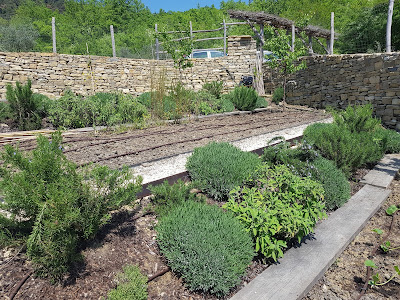
As well as renovating the old farmhouse, Anna and Matt have planted fruit trees in the meadow below the house, and in the main garden, giving them figs, quinces, peaches, grapevines, kiwi fruit - a very popular shade-giving plant in Istria - and sour cherries. They have also restored the old kitchen garden, abandoned for over 30 years, with a new stone wall boundary and edged beds.

Anna invited me to come out to Bolara 60 to work on planning and planting the vegetable garden at the start of the 2018 season. Armed with my best secateurs, a suitcase full of seeds, and Anna's vegetable wishlist, I set off for Bolara 60 via Stansted and Ljubljana for a two-week working stay.

The vegetable garden is optimally situated on a south-facing slope. A line of bamboo (still standing among the ruins when Anna and Matt first set eyes on Bolara 60 in 2012) at the foot of the hill soaks up the water that runs down the slope, and provides canes to support beans and other climbing plants. Also here is the strawberry bed, and a separate perennial herbs bed with rosemary, thyme sage, lemon verbena, lemon balm, tarragon, and lovage. The banks are planted up with more rosemary, thyme and sage bushes and also lavender. Globe artichoke plants, apricot and plum trees line the side walls. That leaves six long rhombus-shaped beds for annual vegetables.


Planning
It's not often that you get a complete blank slate to work on with a vegetable garden. Matt rotovated all the beds, which were then left a few days before being hand-weeded. We - a team comprising Anna, myself and Bolara 60 volunteer Caitriona Courtney - cleared out the beds. Any perennial plant which was taking up valuable space was moved. Two globe artichoke plants were moved to nearer the side walls, where they sulked for a week before deciding to make a go of it and put on new growth. A couple of gooseberry bushes were taken out of the beds and transplanted to a shadier place between the kitchen garden and the house - ten days later, they were already showing tiny incipient fruit.

The garden needs to supply the kitchen and a continual houseful of guests, so there was much discussion about which crops to concentrate on. Anna and Matt don't at the moment want to grow potatoes or onions - plenty always available in the local farmers' markets. They do however want lots of tomatoes and various beans, from Borlottis to local varieties whose seeds are wrapped in unmarked paper bags. Tomatoes can be made into passata and used throughout the winter months, while the beans can easily be dried and likewise kept for months. So after some mapping and redrawing, we divided the beds into 1) tomatoes, 2) beans, 3) courgettes and cucumbers, 4) lettuces and salad leaves, 5) brassicas and beets, and 6) bitter leaves and roots.

Chillies and aubergines could be planted in the narrow beds set against the south-facing rear wall and benefit from the heat reflected off the stone, and Anna was also keen to grow squashes. Why not train them up the wall to scramble over the top instead of rambling haphazardly over the garden? There was space at the sides to dig out 60cm wide beds and grow the squash here. Melons could go along the side wall as well.

Sowing
Sitting at the long dining table, which comfortably accommodates up to 16 guests in season, we pooled our seed resources. I'd brought with me a selection of Franchi seeds, with their provenance mainly in northern Italy, just over the border 45 minutes away, some old favourites such as my carefully hoarded Turkish rocket and tomatillos, and some that Anna had requested: purple sprouting broccoli, and good eating squash.

We stocked up on seed-sowing modules from a local agrarija (like Wickes, if only Wickes sold rows and rows of 250ltr vats for making wine, and olive oil presses) and spent a happy afternoon or two sowing 45 varieties of vegetable and constructing a mini-greenhouse from plastic sheeting and split canes. In fact we ended up calling on Caitriona's experience as a trained architect to advise on the design of the mini-greenhouse and her expertise paid off: the mini-greenhouse worked superbly.


I miscalculated the adjustment required between a Mediterranean climate (Istria) and a warm temperate one (London). While the squash seeds germinated after about a week and the brassicas in just a few days, as they do in the UK, the salad leaves, sown directly into the open ground, clearly enjoyed the warmth and the irrigation and germinated within 48 hours, Puzzlingly, the tomatoes wouldn't germinate at all. "How is this possible?" I asked. "Tomatoes always germinate." But I had failed to take into account that while the days were very warm, the nights were still cold, and the drop down to 10-12 degrees was too cool for the tomatoes. The tomato modules were brought indoors and seedlings started to appear in the next day or so.

Planting
Garden centres aren't as plentiful in Istria as in the UK, but the agrarijas sell seedlings in season and are well worth visiting in spring to pick up new stock as it comes in. We found chilli and aubergine plants, local tomato varieties, courgette and watermelon seedlings, which could go straight out into the garden and save a lot of space in the mini-greenhouse. The irrigation lines - essential in this Mediterranean climate where the year's rain falls mostly in winter and spring - were realigned to ensure that all the germinated seedlings and bought plants were getting their fair share.

Growing
By the end of the fortnight, we felt we'd made good progress. The brassicas were all in, the salad leaves growing apace, and the courgettes, chillies, aubergines and tomateos all well established and putting on good growth. Here's hoping for a bumper season at Bolara 60 this summer - Anna has reported that since I've been back in London, they have had their first batch of strawberries, their first artichoke and there are tiny courgettes already forming. 

I'm planning to return in October to help with the harvest and to get the garden ready for the winter months. For more details about Bolara 60 and planning a visit, see the website at http://www.bolara60.com/, or for more on this stunning and unspoiled part of Croatia, look up Istria at https://www.visit-croatia.co.uk/croatia-destinations/istria/.


The outdoor grill: the large stone dining table is made from a single slab excavated during the renovation of the main house.
Kiwi fruit vine: the large leaves provide welcome shade in summer, and plenty of fruit in the autumn.

Shrubby herbs planted into the steep banks help to prevent soil erosion with their spreading roots and also attract bees and other beneficial insects int the kitchen garden. 

An old wood-fired range, now reborn as a strawberry planter.


Monday, 14 May 2018

Architectural greenery in South London


The owners of this town garden in south London wanted a lush visual vista all the year round. They freely admitted that at present they didn’t spend much time in the garden and hoped that the installation of a large deck would make relaxing in the open air more enticing. They also requested artificial turf for its looks and zero maintenance.
The new deck was built using Saige composite boards and given the size of the lawn we suggested the clients should look at a high end product for an artificial turf that would stay looking good for as long as possible, selecting Easigrass’s Mayfair brand.
Cersis canadensis showing its autumn colours
The new planting centred on a number of focal points including a handsome Cersis canadensis (Forest Pansy) with its mahogany-purple leaves in autumn and bright mauve blossom in the spring, and the Cordyline australis, a firm favourite plant with the clients. The existing fig tree which threatened to dominate the whole of the left hand side of the garden was hard-pruned and thinned to create a much more open, structural shape and a fern garden at the back on the right hand side made the most of a dark, shady area.


Spotlights were installed to pick out the shapes and forms of the shrubs and small trees and make the garden visually welcoming at night.
A simple timed irrigation system ensures that the clients don’t have to worry about watering and they are happy to report that they now eat out, enjoy early evening drinks and have spent more time in the garden in the last year than in the whole of the preceding decade.
Alek and his team at Alek Nikolic Landscape Contractors did a great job building the deck and other hard landscaping in the garden. Easigrass installed the lawn. Armadillo Electrics installed the beautiful garden lighting.


Thursday, 1 February 2018

Taming the Yacon monster


I have grown a monster. This is the harvest from just one plant, grown from a tiny seed tuber back in April 2017. Each one of those long oval roots is the size of a marrow. For all that it looks like a sweet potato it is in fact a yacon (Smallanthus sonchifolius), a tuberous perennial hailing originally from South America, historically grown on the eastern slopes of the Andes. It's also known as Peruvian ground apple and, in its native South America is also confusingly known as jicama. It's definitely not a jicama, though - jicama is a Mexican legume also grown for its underground rhizomes, although the taste is not dissimilar.

It is however related to the Jerusalem artichoke and therefore also kin to the sunflower. The relationship becomes apparent when the plant begins to grow in early summer with its sturdy, slightly hairy, stem and broad leaves. At the end of summer the yacon plant produces small bright yellow flowers very similar to those of the Jerusalem artichoke.


I first read about yacon in Mark Diacono's book A Taste of the Unexpected. At the time I was experimenting with growing oca, another South American tuber, and finding the results somewhat underwhelming. The idea of devoting yet more space to another 'lost crop of the Incas' did not really  appeal.

I was surprised by just how vigorous and tall the yacon plants grew, reaching around 2m by August. Even so, I had no idea what lay beneath until I harvested the first plant at the beginning of November. That yielded three fat sweet-potato-sized tubers, and I was pretty pleased with myself, so much so that I tweeted the following:


Little did I realise that I'd just pulled up the (very much) smaller of the two. The second plant I left to grow on, mindful of Mark Diacono's advice that the roots will stay happily in the ground until - and beyond - the first frosts.


There's no way I can use all this yacon at once. After adding them to salads where the mildly sweet, juicy crunch gives a winter salad some welcome texture, I also tried yacon remoulade, stirring julienned yacon into creme fraiche laced with mustard and a bit of lemon juice. They were julienned again with carrot for a dish based on a south-east Asian papaya salad: sprinkled with a dressing made with fish sauce, lime juice, crushed garlic and sugar, and topped with cashew nuts. That went down very well.

The roots store like potatoes: keep cool - say, around 5-10 degrees Celsius - in the dark, not too dry (they will wither), but definitely not damp (they will rot). Some roots won't keep, but those that do should stay good for weeks if not months.

There's also no need to to buy yacon starter plants each year. Once the giant swollen tubers have been removed, you're left with the stems and the small round buds around the crown. These will grow again the following season. Bury this remaining haulm and nodules in barely damp soil or sand and keep somewhere cool and dark - possibly the same place that is storing the roots for eating. Plant out again in spring, somewhere sunny and well mulched with manure, once the soil has warmed up a bit and the frosts should be over.  

You should probably protect the new leaves from slugs and snails, but I found the emerging plants needed little in way of cossetting. Last year was a notably good growing season for many 'long season' crops so it will be interesting to see how they do this year in whatever conditions 2018 throws up.

Wednesday, 6 December 2017

Autumn tomato chutney

Tomato blight ripped through the allotment in August this year, turning stems and leaves sooty-black and blotching the fruit. Every plant was dug up and burnt by August Bank Holiday leaving just the greenhouse plants, safe behind closed doors, to carry on free of infection.

My greenhouse isn't frost-free and we've had a few very cold mornings now, with the temperature dipping just freezing. While the chilli plants seem to be able to withstand temperatures hovering around zero, the tomatoes are grinding to a halt, the plants looking pretty exhausted, with brown papery leaves and wizened stems, just a few small fruit still slowly turning red in the sunny days.

I decided last week that it was time to put them out of their misery and to gather up all the remaining fruits, whether ripe or not, and make a big batch of late harvest chutney, so that none go to waste.

I've called this autumn tomato chutney because while it might lack some of the sweet sunshine and honeyed notes of tomatoes picked in high summer, the rag-tag of season's end tomatoes, green, pinkish, orange and red in places, has a concentrated, distinctively sharper flavour.

I added a few more autumn pickings: the last of the huge glut of tomatillos, which restore some of the zingy freshness of flavour, a warm chilli or two from the greenhouse for a little bit of fruity heat, and also one of my favourite chutney ingredients, dates. I use these instead of sultanas or raisins quite simply because I like them better, but also because they add a depth of sweet flavour, and a fudgy texture that definitely contributes to the finished chutney.

Apart from that, I kept the recipe as simple as possible - I don't think chutneys are meant to be complicated either in quantities or method. If you sterilise the jars and lids and utensils, this chutney will keep for a year or so - leave it for three months to mature before starting to eat it.


Autumn tomato chutney
500g tomatoes, mixed green and red
300g tomatillos
500g yellow onions
3 cloves garlic
Large thumb of fresh ginger
500g cooking apples
200g dried pitted dates (I used Deglet Nour from Waitrose but any will do)
300ml cider vinegar
175g soft brown sugar

Chop the tomatoes, onions, garlic and dates. Peel and grate the ginger. Remove the papery husk from the tomatillos and rinse any sticky residue off under the tap. Give a quick shake to throw off most of the moisture. Peel and core the apples, then chop roughly.


Put all the ingredients into a large non-reactive pan and mix with a spoon. You might want to hold back 25g or so of sugar and add it to taste as the chutney cooks, depending on how sweet your tooth is.

Bring to the boil over a medium-high heat, then cover the pan, reduce the heat and simmer for an hour and a half by which time the chutney should be dark and thickened.

While the chutney is simmering, sterilise jars for potting up. The amounts given here will fill around six or seven 250ml jars. I think the easiest way to sterilise them is to run them through the dishwasher on a hot cycle, then dry them off in the oven at 120 degrees while the chutney is bubbling away. You should also sterilise the lids and the utensils used for transferring the chutney.

When ready, spoon the chutney into the prepared jars, seal and leave to cool on a wire rack. Label, and transfer to a cool dark cupboard to mature before eating.