Showing posts with label winter garden. Show all posts

Thursday, 17 February 2022

Hellebores - winter jewels in the garden

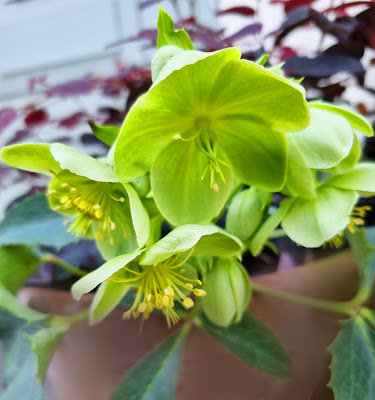
Helleborus argutifolius - Corsican hellebore

Hellebores are brightening up the garden right now, both in containers and under the Acer, where they mingle with the snowdrops and aconites to create a miniature woodland glade in my town garden.
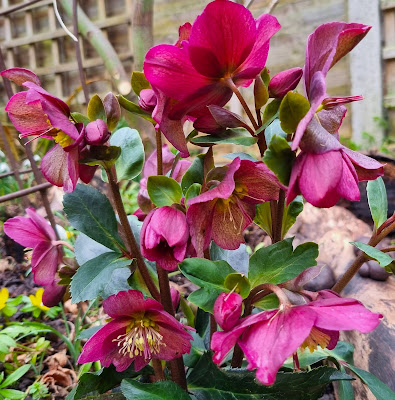
Helleborus 'HGC Mme Lemonnier'

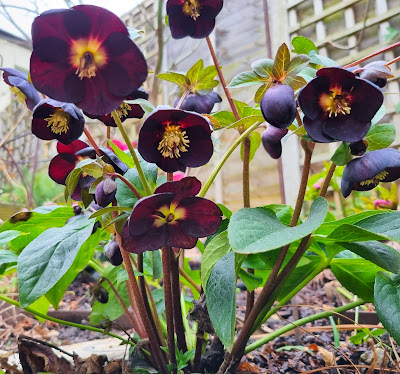
I love the rich jewel colours of H. 'HGC Mme Lemonnier', above (that gorgeous crushed-velvet red), and the dark midnight purple of H. x hybridus 'Naomi', below. But I always come back to the ice green of H. argutifolius and H. niger 'Christmas Carol ', with its pure, pure white flowers, to plant over and over again, in pots, to lighten up the patio and pathways.


Helleborus x hybridus 'Naomi'


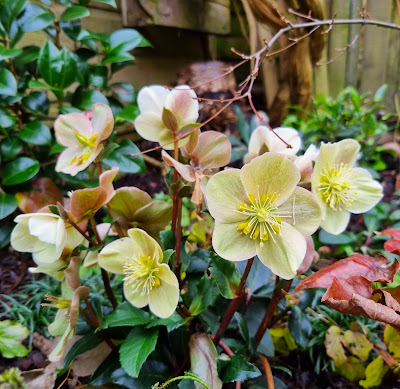
Helleborus 'HGC Cinnamon Snow'


Helleborus niger 'Christmas Carol (Christmas Rose)


Wednesday, 22 January 2020

January containers - brighten up the garden in the depths of winter


Many garden do not look their best in winter. Bare branches, or perennials which die down completely in the dormant season, can leave you with some rather grey and flat spaces. There are however, plenty of plants which look their best in winter and while you may not have the space or the inclination to create a dedicated winter garden such as those at Anglesey Abbey, you can certainly brighten up a shady corner or a dark chilly patio with some large containers full of winter colour. 

The bare red stems of Cornus sanguinea 'Midwinter Fire', above, provide a vibrant framework for this container which is full of warm colours. The amber-bronze winter foliage of Euonymus fortunei 'Emerald and Gold' complements the fiery stems and the soft yellows of Primula vulgaris add a cooler tone. The fern, Blechnum spicant, adds contrasting texture to the display and the snowdrops - Galanthus nivalis - complete the woodland vibe. There are also bright yellow aconites in here which will be pushing upwards and flowering within the month. 

These plants are all happy in shade and so this is a display which would be happy in a dark corner of the garden. Once the season is over, you can plant them out in the garden: the snowdrops and primroses will spread over time to give you bright ground cover at a time when the ground can be a  bit bare.

Other possibilities for this container, following the colour and texture themes, could be a Mahonia eurybracteata 'Soft Caress' with its fine foliage and yellow candle-like flowers, or a small flowering Hamamelis (witch hazel).


The silvery notes in the container above combine the dwarf Pinus mugo with Helleborus niger with its pure white flowers, lavender and Hedera helix 'Glacier', a variegated trailing ivy. This can bring light and texture to patio space and will be happiest out in the open. You could also add some white cyclamen to the planter, which also has Fritillaria meleagris in both its distinctive snakeskin purple and white flowered forms just pushing through the soil surface now to flower in early spring.


Other variations on this theme add white-flowered Hebe or Festuca glauca to accentuate the blue-grey notes of the lavender and ivy. Given a large enough containers,these plants could be grown all the year round in the pot, or replanted in the garden once the flowering season is finished.


Cornus sanguinea 'Midwinter Fire', as in the container at the top of this post, is used extensively in winter gardens such as those at Anglesey Abbey, above, the avenues of flamecoloured stems creating a dramatic display. Anglesey Abbey also has impressive stands of bright white birch trees and at this time of year, the ground is carpeted with snowdrops.  Red- and purple-stemmed Cornus will also give the same effect - see the winter garden at the Cambridge Botanical Gardens, below.


Thursday, 2 February 2017

Winter colour at Golders Hill Park


On a sunny day, the small - but perfectly formed, of course - winter beds in Golders Hill Park in north London bring a welcome glow and colour when the weather is cold and the days are short.

Most of us have gardens that look a bit grey, twiggy and bedraggled in winter. But winter gardens can be surprisingly colourful, making the most of  berries, stems and bark to make a warm and striking display. One of the UK's best known winter gardens is at Anglesey Abbey near Cambridge; The nearby Cambridge Botanical Garden has an impressive winter garden, as does Hillier Gardens in Hampshire. All of them have the bright stems of Cornus - the flowering dogwood - set against the white bark of Betula jacquemontii - as their centrepiece. After that, trimmed architectural evergreens can act either as a backdrop or to create striking silhouettes against a winter sky. Ribes cockburnianus is another popular plant with its arching chalky silver stems, and the black blades of Ophiopogon planiscapus nigrescens offer contrast in edging many winter borders.

Golders Hill Park in north London, managed by the Corporation of London, has a relatively tiny but still impressive winter display edging the more formal beds behind. The classic Cornus sanguinea 'Midwinter Fire' contrasts with the Betula trunks, and this year the Nandina domestica shrubs have produced masses of red berries (below).

The purple stems of Cornus alba 'Kesselringii' are distinctive but to my mind it is 'Midwinter Fire' with its bright yellow stems tipped with red which looks particularly warming and attractive especially when planted as high density.


The purple stems of Cornus alba 'Kesselringii' add a darker, shadowy effect to the other Cornus cultivars and the white birch trunks behind. 

Bright scarlet berries top out the bronze winter foliage of Nandina domestica


Golders Hill Park also boasts its own stumpery, a revival of a Victorian fashion, where tree stumps are arranged naturalistically to become a part of the landscape and provide a structure or backdrop for plants. The stumps are not treated with any preservative and will decay very slowly over time to become a part of the woodland floor, as well as providing nesting and feeding sites for insects and birds and with hiding places for small mammals such as hedgehogs.  I love the way the dappled light is caught on the tips of the wood and highlights the shape and the grain.


Friday, 23 January 2015

Winter gardens


Even though it has its brave stands of leeks and the brassica bed is lush and green, the allotment does not look at its best in January.There are not yet any signs of spring on the way and every thing looks grey and downtrodden in the wet.

Time to raise the spirits with a visit to places which come into their own in the winter. My own outside space might be looking sorry for itself, but the winter garden at the Cambridge University Botanic Garden (above) sings with colour at this time of year and the winter walk at Anglesey Abbey (below) is at its most spectacular, And happily they are just a few miles apart and easily visitable in the same day.

Despite the rain, the colours of Anglesey Abbey's Winter Walk are vibrant

Relatively underplanting beneath Cornus sanguinea 'Midwinter Fire' hides the less colouful main stems. The silvery stems of Rubus thibetanus 'Silver Fern' make the beds look as though they have been sprinkled with frosting.


Contrats in form and colour with conifers and grasses at Cambridge University Botanic Garden.

The venerable Pyrus communis 'Pitmaston Duchess' espalier at Anglesey Abbey

The sun came out in the afternoon, bringing some welcome warmth to the woodland paths at Anglesey Abbey
Details
Cambridge University Botanic Garden
1, Brookside, Cambridge CB2 1JE
Open 10.00am-4.00pm January; 10.00am-5.00pm, February and March; 10.00am-6.00pm April to September.
Admission price: Adults: £5.00, concessions: £4.50; children under 16: free

Anglesey Abbey
Anglesey Abbey, gardens, and Lode Mill, Cambridgeshire, CB25 9EJ
Garden open 10.30am-4.30pm January to March; 10.0am-5.30pm April to October
Admission price gardens and mill: Adults: £7.10; children: £3.75